
 中文
中文Ballking Valve Balls: Analyzing the Factors Influencing the Quality of Hard-Sealed Balls and Seats
In the field of industrial fluid control, hard-sealed balls and seats serve as the pressure-bearing sealing components of valves; consequently, their quality directly determines a valve's sealing performance, service life, and operational stability. Wenzhou Ballking Valve Co., Ltd. has dedicated itself to the R&D and manufacturing of valve components for many years, leveraging its meticulous control over the production processes for hard-sealed balls and seats to deliver reliable products for a wide range of demanding industrial applications. The following analysis examines—from several key dimensions—the core factors influencing the quality of hard-sealed balls and seats, thereby demonstrating Ballking Valve's unwavering commitment to product excellence.
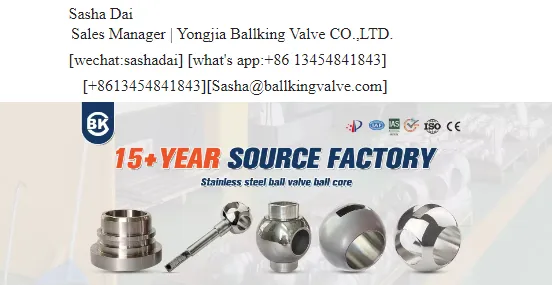
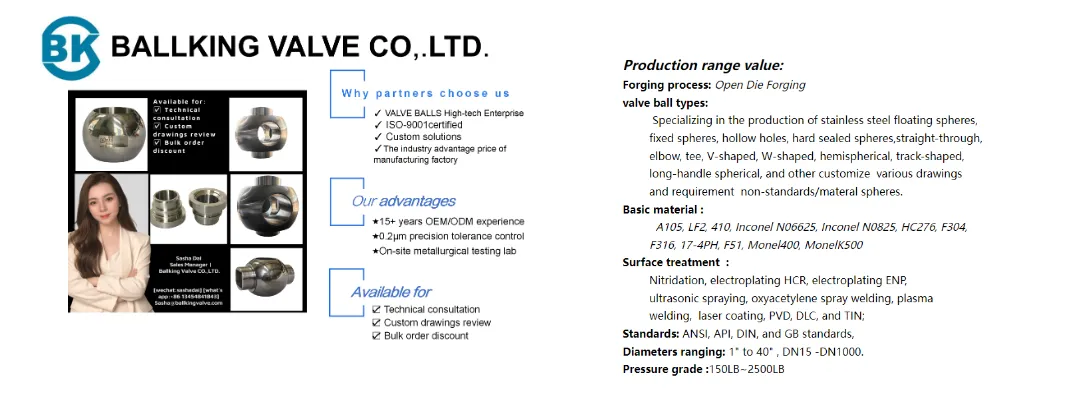
The performance of raw materials directly determines the fundamental quality of hard-sealed balls and seats, serving as the core prerequisite for a product's resistance to wear, corrosion, and high temperatures. High-quality hard-sealed components require the selection of metal materials characterized by high strength, high hardness, and strong chemical stability—such as specific grades of stainless steel or cemented carbides. These materials are capable not only of withstanding impact loads under high-pressure operating conditions but also of resisting erosion from acidic, alkaline, or high-temperature fluid media. At the raw material procurement stage, Bokang Valves establishes rigorous screening standards; every batch of raw materials undergoes chemical composition analysis and mechanical property testing to ensure that material purity and performance meet required specifications, thereby preventing issues such as seal failure or component wear caused by material defects at the very source. Conversely, if inferior materials—or those ill-suited to specific operating conditions—are selected, even the most precise subsequent manufacturing processes cannot prevent premature wear, corrosion, or leakage between the ball and seat during operation, thereby drastically shortening the valve's service life.
Processing Precision Control: The Key Guarantee for Sealing Performance
The sealing effectiveness of hard-sealed balls and seats relies on the precise alignment of component surface finishes and structural dimensions; insufficient processing precision directly results in a loose fit between sealing surfaces, leading to fluid leakage. During the manufacturing process, critical parameters—such as the ball's sphericity and surface roughness, as well as the seat's sealing groove depth and perpendicularity—must be strictly controlled through the use of high-precision machining equipment and rigorous inspection methods. For instance, Bokang utilizes precision machinery—such as CNC lathes and grinding machines—to process its valve balls, ensuring that surface smoothness meets the highest-grade standards and preventing sealing gaps caused by surface scratches or irregularities. Simultaneously, inspection tools—such as coordinate measuring machines (CMMs)—are employed to conduct full dimensional accuracy checks on every production batch, ensuring that the clearance between the ball and seat is maintained within an extremely tight tolerance range to achieve a leak-proof seal. If processing precision is inadequate—for example, if the ball's sphericity deviation is excessive or the seat's sealing surface is misaligned—the contact area between the two components is reduced, resulting in uneven distribution of sealing pressure; under high-pressure operating conditions, this creates a high risk of leakage, thereby compromising the operational safety of the entire fluid system. Sealing Surface Treatment: A Core Process for Enhancing Durability
The sealing surfaces of hard-sealed balls and seats must withstand prolonged friction and media erosion; consequently, the surface treatment applied to them directly determines their resistance to wear and corrosion, making it a critical factor in enhancing product durability. Common sealing surface treatment processes include hard alloy surfacing, plasma spraying, and nitriding. These techniques create a protective layer on the metal surface characterized by high hardness and density, thereby bolstering the sealing surface's resistance to abrasion while simultaneously improving its tolerance to harsh operating media. Based on the specific requirements of various operating conditions, Bokang Spheres selects the most suitable surface treatment processes for its hard-sealed components. For instance, products designed for high-temperature and high-pressure environments undergo hard alloy surfacing, a process that significantly boosts the hardness of the sealing surface, enabling it to withstand prolonged friction without easily deforming. Conversely, for applications involving corrosive media, special coating treatments are applied to isolate the metal substrate from direct contact with the media, thereby preventing corrosion of the sealing surface. Improper sealing surface treatment—such as uneven coating thickness or insufficient bonding strength—can lead to the detachment or accelerated wear of the protective layer during operation. This, in turn, can result in sealing failure, driving up equipment maintenance costs and increasing safety risks.
Heat Treatment: A Vital Step in Optimizing Material Performance
Heat treatment is a crucial process for adjusting the internal microstructure of hard-sealed balls and seats, thereby optimizing their mechanical properties; it directly influences the balance between the components' strength, hardness, and toughness. Through carefully controlled heat treatment processes—such as quenching, tempering, and aging—internal stresses generated during material processing can be relieved, preventing component deformation caused by stress relaxation during operation. Simultaneously, these processes enhance both the hardness and toughness of the material, ensuring that the ball and seat components can withstand high-pressure impacts without becoming overly brittle and prone to fracture. Hongrui Valves maintains rigorous control over temperature, holding times, and cooling rates during the heat treatment phase. By formulating customized heat treatment protocols tailored to the specific characteristics of each material, the company ensures that the mechanical properties of every product batch remain stable and consistent. Conversely, if heat treatment parameters are improperly controlled—for example, if excessive temperatures lead to coarse grain structures or rapid cooling induces cracking—the mechanical performance of the components will be compromised. Under high-pressure or frequently cycled operating conditions, such components become susceptible to deformation and fracture, thereby severely disrupting the normal operation of the valve. Quality Inspection System: The Final Barrier Against Substandard Products
A comprehensive quality inspection system serves as the ultimate safeguard for ensuring the consistent quality of hard-sealed balls and seats. Only through a multi-dimensional, end-to-end inspection process can defects arising during production be detected in a timely manner, thereby preventing substandard products from entering the market. Wenzhou Hongrui Valve has established a holistic inspection mechanism spanning the entire workflow—from the receipt of raw materials to the shipment of finished goods. During the raw material stage, we verify chemical composition and mechanical properties; during processing, we inspect dimensional precision and surface quality; and at the finished product stage, we conduct sealing performance tests, pressure resistance tests, wear resistance tests, and other evaluations to simulate actual operating conditions and validate product performance. For instance, during sealing performance tests, we utilize pressure testing to verify the sealing efficacy of the ball-and-seat assembly, ensuring zero leakage under rated pressure. Similarly, wear resistance tests simulate frictional scenarios encountered during long-term operation to validate the durability of the sealing surfaces. Without rigorous quality inspection, even if upstream controls are meticulously executed, defects caused by unforeseen variables could still result in the release of flawed products—posing significant safety risks and financial losses to our customers.
Quality control for hard-sealed balls and seats constitutes a systematic engineering endeavor that encompasses every stage: raw materials, processing, surface treatment, and inspection. Even the slightest deviation at any single stage can compromise the final performance of the product. Adhering steadfastly to the philosophy of "Precision Manufacturing, Quality First," Wenzhou Hongrui Valve has established stringent production and inspection standards centered on the aforementioned critical factors. We are dedicated to supplying high-performance, long-life hard-sealed components to sectors such as petrochemicals, electric power, and water treatment. By leveraging the superior quality of our core components, we empower our customers to enhance the stability and safety of their fluid control systems—thereby demonstrating the profound sense of responsibility and formidable capabilities of a professional valve component manufacturer.
